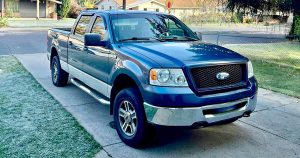
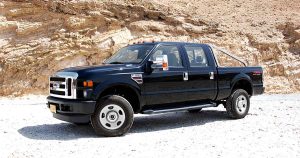
Ford F-250 is the ‘Super Duty’ truck for a reason. So, if having a powerful vehicle is vitally important for you, then you might want to consider getting this beast. One of the best things about the truck is that it features cutting-edge technology that makes towing easy and smooth.
The truck with a 6.2L V8 engine will be able to tow 15,000 pounds. If it has the 6.7-liter turbodiesel V8, the towing capacity can reach 20,000 and even 22,800 pounds when joined by the 5th-wheel gooseneck.
Keep on reading to find out if the Ford F-250 has what it takes to become your next work buddy.
How Much Can a F-250 Pull with a Tow Package?
Do bear in mind that for a 20,000-pound conventional tow rating, everything that’s included in the High-Capacity Trailer Tow Package (535) must be installed. If you tow without the items, your limited warranty might be voided.
Depending on the type of towing and a few other factors, the high-capacity tow package can add anywhere between 200 and 4,000 pounds of towing capacity. You’ll reach a 20,000 capacity for conventional towing if the configuration has the high-capacity tow package, turbodiesel V8 engine, 4×4 drivetrain, and crew cab. With the same engine and tow package and a regular cab and 4×2 drivetrain, you’ll get 22,800 pounds of gooseneck towing capacity.
The content of the tow package may vary depending on the model, trim, and powertrain, but it would usually include an upgraded rear axle, increased GCW, and a trailer brake controller.
Test Your Ford Truck Knowledge!

How Much Can a F-250 EcoBoost Tow?
‘EcoBoost’ is Ford’s line of turbocharged, direct-injection petrol engines. They are able to provide greater torque and horsepower thanks to their power metrics and incredible efficiency. By the way, the engines from this series achieve about 30% better fuel efficiency and emit 15% less greenhouse gases.
At the moment, Ford only offers their F-150 with the EcoBoost technology. The 3.5L EcoBoost V6 tows up to 14,000 pounds, while the V8 engine tows 13,000 pounds. Unlike the F-250, F-150 does not offer fifth-wheel/gooseneck towing for simplifying heavy-duty tasks, so towing more than that won’t be possible.
Though some experts are sure that the EcoBoost engines will eventually make it to the super-duty truck line-up, it might still take years for that to happen. Perhaps, that is mainly because an average heavy-duty customer would prefer not to use expensive premium fuel in their truck (even though, in theory, EcoBoost engines might have significantly improved the vehicles’ performance).
What Is the 80/20 Towing Rule?
The 80/20 towing rule is, basically, a safety measure that the majority of RVers follow. The cold numbers provided by the manufacturer can often be overlooked when towing. But the rule can serve as a good guideline for a safe and smooth driving experience.
In a nutshell, the 80/20 towing rule states that you should never tow over 80% of your maximum towing capacity (the latter can be calculated by subtracting the truck’s curb weight from its GCVWR). First of all, this rule gives a bit of room for error in calculations (we’re all human, after all). Secondly, it helps protect your vehicle as you won’t be constantly pushing it to its limits when towing.
Towing certainly does put plenty of stress on your vehicle. But considering that you’re, most likely, relying on your truck in your everyday life, you would definitely not want the suspension or the brake system to fail. Among other things, following the 80/20 rule will help you reduce the wear and tear that your truck has to experience.
What Is the 60/40 Towing Rule?
If trailers are not properly equipped, set up, and towed, they might end up leading to a tragedy. Vehicles that are towing the trailers brake and corner differently, and the stopping distances can become two times longer. Furthermore, trailer sway is something that can potentially lead to a rollover or crash.
The likelihood of a trailer sway can be significantly reduced if you manage to follow the 60/40 rule which states that 60% of the total weight of the trailer should be put in front of the axles and 40% of the load weight – behind the axles. This will help ensure that just enough weight rests on the hitch and that there is not too much load positioned behind the axles.
If your trailer does start to sway, make sure to hold the wheel straight and carefully apply the brakes (let off the gas). To prevent this from happening again, redistribute the total load, if there is such a need, and try to drive slower.
How Big of a Trailer Can a F-250 Pull?
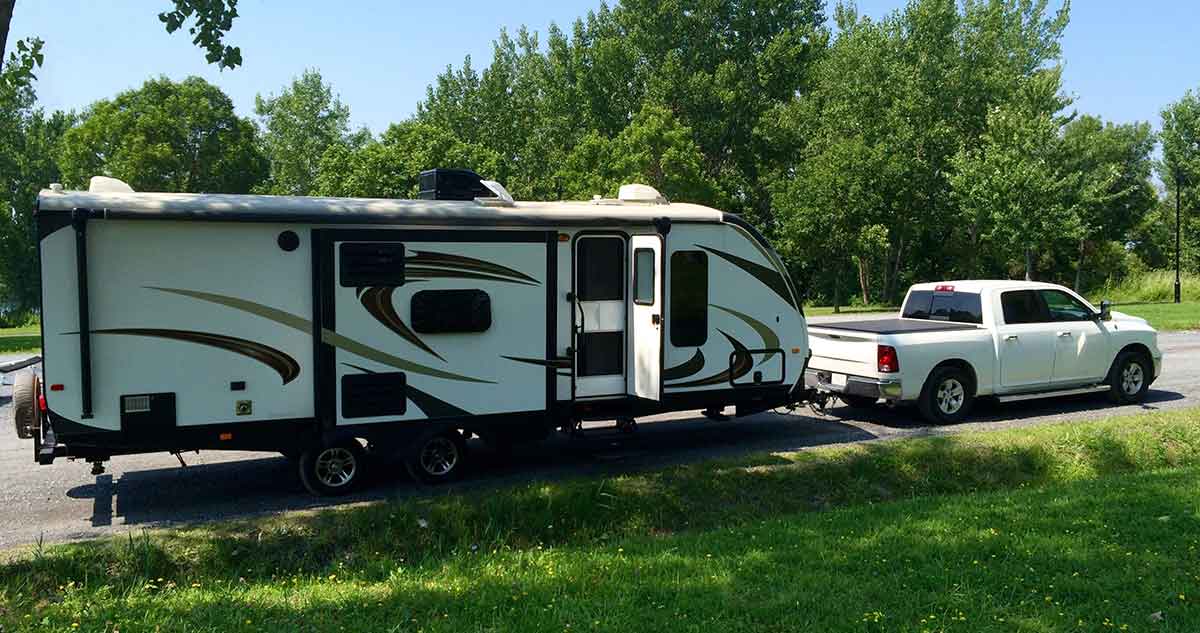
The dry weight of a standard trailer is around 5,200 pounds. Do bear in mind, however, that this is the empty weight of a fully assembled trailer, and that you would also have to determine the payload capacity, the trailer’s load limit, and the tongue weight before hitting the road.
The 6.2-liter V8 engine gives the F-250 truck the ability to tow up to 15,000; the 6.7L turbo diesel – up to 20,000; the 7.3L V8 engine – 15,000 pounds that can be extended to 19,500 (when equipped with 5th-wheel/gooseneck towing). In a word, the Ford F-250 would be able to pull practically any trailer, as long as you consider all the necessary numbers, it can even tow a Bobcat Skid Steer.
The larger travel trailers are around 9,000 pounds. But when fully loaded with cargo, fluids, and supplies, the gross vehicle weight can increase to 10,500 pounds and more. So, always do the necessary calculations, instead of simply relying on the dry weight of the trailer.
What Happens If I Tow More Than Capacity?
Maximum towing capacity should not be taken lightly and you should never exceed it (ideally, you wouldn’t want to even get too close to that number). In the worst-case scenario, towing more than capacity can lead to property damage, serious injury, and even death.
If you’re towing too much weight, your trailer will, most likely, start to swing and pull your vehicle out of control which will make it difficult for you to maneuver and stop. Sometimes, you might not notice the effects of exceeding towing capacity, but, eventually, your brakes will fade, the tires will fail, the life of the transmission will be shortened, and your engine will overheat.
Finally, it is simply against the law to tow more than the towing capacity of your truck. Some officers are well-trained in identifying overweight and improperly operating vehicles. If the towing vehicle is not properly reacting to normal maneuvering, you can get pulled over and if towing more than capacity becomes the reason for an incident, you might be found liable through a legal process.
Take the HARD Ford Truck Quiz

Final Thoughts
The Ford F-250 can tow anywhere between 15,000 and 22,500 pounds, depending on the engine, cab and bed configurations, and a few other factors.
Even though this truck will be able to pull practically any trailer, you should always follow the 60/40 and the 80/20 rules. These simple calculations will help make sure that you have a safe experience on the road and that your F-250 continues performing at its best over the course of many ye

Valik loves tinkering in the garage and is currently restoring a 2000 GMC Sierra 1500 truck. He also writes about the progress on this blog. When not in the garage, Valik is also a web developer and a blogger. I know, strange, a hand in two completely different worlds. And that is the way he likes to keep it.